

Bruce Willis disease is a question millions of fans have searched since the Die Hard star quietly stepped away from Hollywood. His condition, frontotemporal dementia (FTD), is rare, often misunderstood, and very different from the memory-loss dementia most people picture. Here is what his diagnosis means, how it progressed, and where his health stands today.
Biography Table
| Field | Details |
|---|---|
| Full Name | Walter Bruce Willis |
| Nickname/Stage Name | Bruce Willis; “Bruno” (music alter ego Bruno Radolini) |
| Date of Birth | March 19, 1955 |
| Place of Birth | Idar-Oberstein, West Germany |
| Age | 71 years (as of 2026) |
| Nationality | American |
| Zodiac Sign | Pisces |
| Profession/Occupation | Actor, producer, singer |
| Years Active | 1980–2022 |
| Education | Penns Grove High School; studied drama at Montclair State University |
| Genre/Field | Action, thriller, drama, comedy |
| Spouse/Partner | Emma Heming Willis (m. 2009); Demi Moore (m. 1987–2000) |
| Children | Rumer, Scout, Tallulah, Mabel, Evelyn |
| Parents | David Willis, Marlene Willis |
| Siblings | Florence, David, Robert (deceased) |
| Net Worth | Estimated around $250 million |
| Hair Color | Bald |
| Notable Works | Moonlighting, Die Hard, Pulp Fiction, The Sixth Sense, Armageddon, 12 Monkeys |
| Awards/Honors | 2 Primetime Emmy Awards, Golden Globe Award, Star on the Hollywood Walk of Fame |
What Disease Does Bruce Willis Have?
Bruce Willis has frontotemporal dementia, a progressive brain disease that damages the frontal lobes and temporal lobes. His family made the diagnosis public on February 16, 2023. Unlike Alzheimer’s, FTD mainly attacks communication, personality, and behavior rather than memory in its early stages.
The family’s first announcement came in March 2022, when they said he was stepping away from acting because of aphasia. Aphasia is not a disease on its own. It is a symptom that affects the ability to talk, write, and understand language, and it can come from a stroke, a head injury, or a degenerative brain disorder.
About a year later, doctors reached a clearer diagnosis. The family said that while the news was painful, it was a relief to finally have a definitive diagnosis. Specialists have since explained that his early speech changes fit a language variant of FTD called primary progressive aphasia (PPA).
When I first covered this story, the most common reader confusion was simple: “Did he have aphasia or dementia?” The honest answer is both. Aphasia was the first visible symptom, and FTD was the underlying cause driving it.
From Aphasia to Frontotemporal Dementia: A Timeline
| Date | Milestone |
|---|---|
| Spring 2022 | Family announces aphasia diagnosis and his retirement from acting |
| February 2023 | Family confirms the diagnosis has progressed to frontotemporal dementia |
| May 2023 | Daughter Tallulah Willis writes a Vogue essay about the family’s journey |
| November 2023 | Emma shares that his condition is difficult to track and understand |
| August 2025 | Emma tells Diane Sawyer he remains physically healthy while his brain declines |
| September 2025 | Emma releases her caregiving book, The Unexpected Journey |
| January 2026 | Emma says Bruce is not aware of his own diagnosis |
| 2026 | Family continues sharing updates; he turns 71 in March |
Early Signs of Bruce Willis’ Dementia
The earliest sign was a vague unresponsiveness. Tallulah wrote that the family first blamed it on hearing loss, joking that Die Hard had damaged his ears. Over time the silence grew, and she admitted she sometimes took it personally before understanding it was illness.
Another telling moment came at Rumer’s wedding planning stage. Emma later shared that the change in his father-of-the-bride speech was one of the red flags the family now recognizes in hindsight. His words did not flow the way they once had.
Bruce also had a childhood stutter, which he famously overcame through acting. Some viewers wondered whether the stutter was connected. Doctors say there is no evidence linking a childhood stutter to FTD, though returning speech trouble in adulthood always deserves medical attention.
Reports from his final film sets described crews noticing he struggled with lines and needed support. In hindsight, these were early language symptoms, not a lack of effort. That shift in perspective is exactly what FTD awareness campaigns hope families learn sooner.
What Is Frontotemporal Dementia?
Frontotemporal dementia is an umbrella term for rare neurodegenerative diseases that cause nerve cell loss in the brain’s frontal lobes (behind the forehead) and temporal lobes (behind the ears). As brain tissue shrinks, a person’s personality, judgment, language, and social behavior change.
The frontal lobes handle decision-making, self-control, and emotional regulation. The temporal lobes manage language and word meaning. That is why FTD can turn a warm, witty person into someone who seems cold, impulsive, or unable to find words, while memory centers stay relatively intact early on.
FTD makes up about 10–20% of all dementia cases. It is also the most common dementia in people under 60. Most patients develop symptoms in their 50s or 60s, though it can appear in the 40s or even the 70s. The medical name for the underlying brain damage is frontotemporal lobar degeneration (FTLD).
The condition was once known as Pick’s disease, and older textbooks still use that name. Today, doctors use “FTD” to cover several related disorders, each defined by which brain area is hit first.
Types of Frontotemporal Dementia
| Type | Main Area Affected | Key Features |
|---|---|---|
| Behavioral variant FTD (bvFTD) | Frontal lobes | Personality change, loss of empathy, impulsivity, poor judgment; most common subtype |
| Semantic variant PPA | Temporal lobes (often left side) | Loss of word meaning, trouble understanding speech |
| Non-fluent/agrammatic variant PPA | Left frontal area | Hesitant, labored, ungrammatical speech |
| Movement disorders (CBS, PSP, FTD-ALS) | Motor areas | Stiff limbs, poor balance, posture changes, Parkinson’s-like symptoms |
Primary progressive aphasia is sometimes called Mesulam’s disease, after Dr. Marsel Mesulam, who first described it. Language variants like the one tied to Bruce Willis tend to begin between ages 50 and 60, although cases have been documented earlier.
Movement-related forms, including corticobasal degeneration and progressive supranuclear palsy, are sometimes grouped as Parkinson’s-plus syndromes. FTD can also overlap with ALS, which damages the nerves controlling voluntary movement.
Common Symptoms of FTD
Symptoms depend on the variant, but they usually fall into three groups:
- Behavioral: apathy, disinhibition, tactlessness, hurtful remarks, compulsive habits, changes in food preferences, poor personal hygiene, and rash decisions such as gambling or shoplifting.
- Language: word-finding problems, halting sentences, reduced comprehension, trouble writing, and eventually loss of speech.
- Physical (later stages): difficulty walking, swallowing problems, and needing help with eating and bathing.
One of the hardest symptoms for families is lack of insight. The person often does not recognize anything is wrong. Emma Heming Willis said in early 2026 that Bruce never became aware of his diagnosis, which she described as both a blessing and a heartbreak.
Families often say their loved one is “not the same person.” That phrase captures FTD better than any clinical definition, because the illness targets the very traits that make someone who they are.
Causes, Genetics, and Who Is at Risk
In most cases, doctors cannot find an identifiable cause for FTD. What they do know is that abnormal proteins, mainly tau and TDP-43, build up inside brain cells and damage them. Researchers are still working out why these proteins accumulate.
Genetics plays a bigger role in FTD than in most dementias. Around 30–40% of people with FTD have a family history of the disease. Three genes cause most inherited cases:
- MAPT (linked to tau protein)
- GRN (progranulin)
- C9orf72 (also tied to ALS)
Unlike Alzheimer’s, APOE gene variants and lifestyle factors like education level or cardiovascular health do not appear to strongly affect FTD risk. A history of traumatic brain injury may raise risk slightly, but the evidence is still developing.
In the U.S., an estimated 50000–60000 Americans live with FTD, though the true number is likely higher because many cases go undiagnosed. Most are diagnosed between ages 45 and 65, which means the disease often strikes during peak earning years and while people are still raising children.
Why FTD Is So Hard to Diagnose
On average, it takes about 3.6 years to get an accurate FTD diagnosis. Many patients see two or three doctors first. Because memory is often spared early, doctors may not even suspect dementia, especially in younger people.
FTD is commonly misdiagnosed as depression, burnout, OCD, schizophrenia, or relationship problems. Movement variants may be mistaken for Parkinson’s. Families sometimes spend years treating the wrong condition while symptoms quietly worsen.
Diagnosis usually involves several steps:
- A detailed medical history, often with input from family members
- Neurological and cognitive testing
- MRI imaging to look for shrinkage in the frontal and temporal lobes
- FDG-PET scans to show reduced brain activity
- Genetic testing when there is a family history
Tests also rule out other causes such as strokes, tumors, and vitamin problems. In my experience writing about dementia, the families who reach a diagnosis fastest are the ones who push for a referral to a specialist memory or neurology clinic early rather than waiting.
Frontotemporal Dementia vs. Alzheimer’s Disease
The simplest difference is this: Alzheimer’s usually starts with memory loss, while FTD starts with behavior or language changes. They also begin in different brain areas and at different ages.
| Feature | Frontotemporal Dementia | Alzheimer’s Disease |
|---|---|---|
| Typical age of onset | 45–64 | 65+ |
| First brain area affected | Frontal and temporal lobes | Hippocampus and entorhinal cortex |
| Early symptoms | Personality change, speech problems | Forgetfulness, getting lost |
| Memory early on | Often spared | Affected early |
| Spatial orientation | Usually preserved early | Wandering and disorientation common |
| Typical progression | About 6–8 years (varies widely) | About 4–8 years, up to 20 |
Later in the disease, the two can overlap. People with advanced FTD may develop memory problems, and people with Alzheimer’s may show behavioral change. Sundowning, the evening confusion seen in Alzheimer’s, is less typical in early FTD.
This difference matters for treatment. Some Alzheimer’s medications that help memory can actually worsen symptoms in FTD, which is another reason a correct diagnosis is so important.
Treatment for Frontotemporal Dementia
There is currently no cure for FTD and no approved drug that can slow or reverse it. Treatment focuses on symptom management, safety, and quality of life. Several clinical trials are testing disease-modifying treatment, especially for genetic forms.
Doctors may use medications to ease specific symptoms:
- Antidepressants (SSRIs) can help with compulsive behavior, irritability, and mood.
- Antipsychotics are used with great caution for severe agitation because of side effect risks.
- Alzheimer’s medications are generally avoided, since they may worsen behavior in FTD.
Non-drug support often helps more. Speech therapists can teach new ways to communicate, occupational therapists adapt the home, and physical therapists help with balance and movement. Behavioral and emotional strategies, such as reducing noise and keeping routines, can prevent many difficult moments.
The best results come from a team: neurologists, psychiatrists, therapists, and trained caregivers working together. The Willis family’s decision to arrange round-the-clock care reflects how demanding late-stage FTD becomes.
Life Expectancy With Frontotemporal Dementia
Most people live about 7–13 years after their first symptoms begin. Survival after diagnosis is shorter, often around 6–8 years, largely because of diagnostic delay. However, the range is wide, from 2 to 20 years.
The variant makes a real difference. Semantic variant PPA tends to progress more slowly, sometimes allowing 10+ years. Forms linked with ALS usually progress faster, sometimes within a few years.
Death is usually caused not by FTD itself but by complications, such as pneumonia linked to swallowing problems, infections, or falls. Good care can reduce these risks and help people stay comfortable longer.
For Bruce Willis, symptoms became public in 2022, and his family says he remains physically strong. Doctors caution that no one can predict an individual’s timeline, since progression is often unpredictable.
Is Bruce Willis Still Alive? Latest Health Update
Yes, Bruce Willis is still alive as of 2026. He is 71 years old and continues to live with frontotemporal dementia, supported by his wife, daughters, and full-time caregivers. His family regularly shares updates to keep fans informed.
In 2025, Emma explained that Bruce is physically healthy and mobile, but his brain is failing him. His ability to speak has declined significantly. The family has learned new ways to connect with him, and they say he still shows flashes of his old self through a laugh or a familiar smirk.
The family also moved Bruce into a separate, specialized home near theirs, where he receives round-the-clock care. Emma said this decision was about his safety and giving their young daughters a calmer home, not about stepping away from him.
In July 2026, he was photographed during a rare car ride in Los Angeles, looking relaxed. His daughter has said he still recognizes the family and greets them warmly, and loved ones describe him as happy and at peace.
Did Bruce Willis Die? Clearing Up Death Hoaxes
No, Bruce Willis did not die. Viral posts claiming he has passed away appear regularly on social media, but none have been true. In 2026, his representatives dismissed one such hoax and confirmed he was at home with family.
These rumors spread because of his serious illness and the long gaps between public updates. Anonymous sources and fake news pages often use his name to drive clicks.
The safest approach is to trust statements from the Willis family or verified news outlets. If a major event happened, his family would almost certainly share it directly, as they have with every health update so far.
How Old Is Bruce Willis?
Bruce Willis was born on March 19, 1955, which makes him 71 years old in 2026. He turned 70 in March 2025, a milestone his family marked with loving public messages.
He was born in Idar-Oberstein, West Germany, where his American father served in the military. His mother, Marlene, was German. The family moved to Penns Grove, New Jersey, when he was a toddler, and that is where he grew up.
His age matters in understanding his diagnosis. He was about 67 when his aphasia became public, which is slightly later than the typical FTD onset window. Language variants of FTD, however, commonly appear in the 60s, so his case fits a recognized pattern.
Bruce Willis Wife and Family Support
Bruce Willis’ wife is Emma Heming Willis, a model and entrepreneur. They married in 2009 and share two daughters, Mabel and Evelyn. Emma has become his primary caregiver and one of the most visible voices in the FTD community.
Bruce was previously married to actress Demi Moore from 1987 to 2000. Together they have three daughters: Rumer, Scout, and Tallulah. Despite the divorce, the two families remain remarkably close and have supported one another openly since his diagnosis.
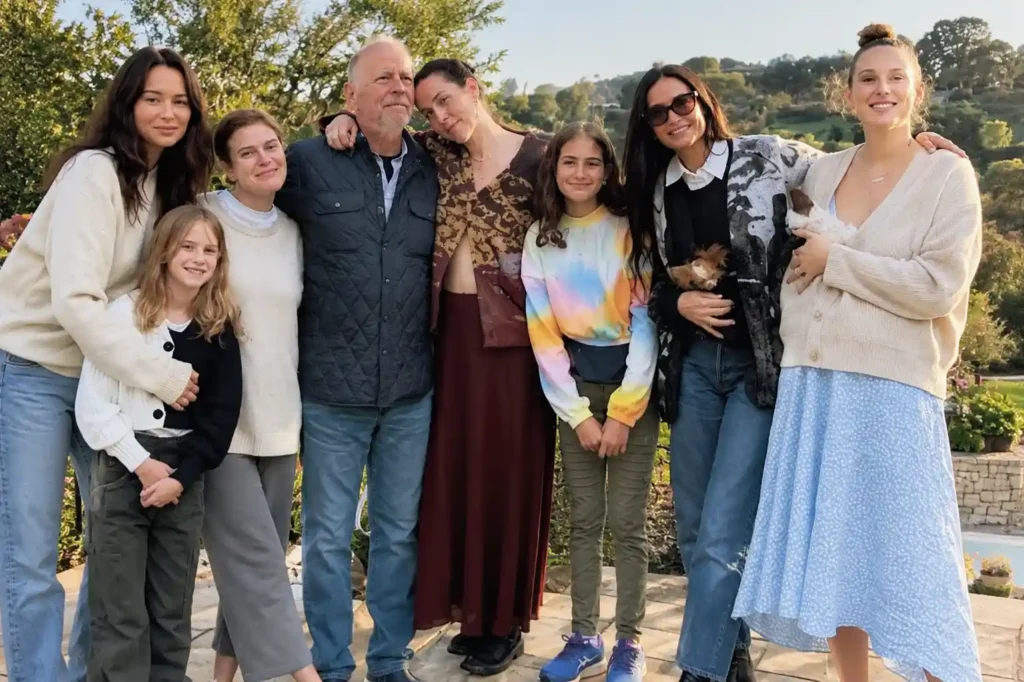
Emma often calls dementia a “family disease,” because it reshapes everyone’s role. Demi has spoken about how the illness brought the blended family even closer. Rumer welcomed daughter Lou in 2023, making Bruce a grandfather during his illness.
In September 2025, Emma released her book, The Unexpected Journey, which offers practical caregiving guidance. She has repeatedly urged caregivers to ask for help early instead of waiting for burnout. In 2026, the couple also launched a fund supporting FTD research and caregiver resources.
Practical Tips for FTD Caregivers
Caregiving lessons shared by Emma and FTD experts can help any family facing this disease:
- Keep communication simple. Use short sentences, speak slowly, and add gestures, drawings, or labeled photos as visual cues.
- Never argue. Behavior comes from brain damage, so respond calmly and try not to take hurtful remarks personally.
- Adjust the environment. Many people with FTD develop sensitivity to noise and crowds, so quieter spaces reduce frustration.
- Plan early. Complete advance directives, a POLST form, and name a healthcare surrogate while the person can still take part.
- Build a care team. Work with speech-language pathologists, occupational therapists, and physical therapists.
- Protect yourself. Join support groups and schedule regular breaks to prevent caregiver burnout.
Bruce Willis Movies and Career Before Retirement
Before his illness, Bruce Willis was one of Hollywood’s biggest action stars. He rose to fame on the TV show Moonlighting in 1985, then became a global icon as John McClane in Die Hard (1988). His films earned billions at the box office.
| Year | Film/Show | Role |
|---|---|---|
| 1985–1989 | Moonlighting | David Addison |
| 1988 | Die Hard | John McClane |
| 1994 | Pulp Fiction | Butch Coolidge |
| 1995 | 12 Monkeys | James Cole |
| 1997 | The Fifth Element | Korben Dallas |
| 1998 | Armageddon | Harry Stamper |
| 1999 | The Sixth Sense | Dr. Malcolm Crowe |
| 2000 | Unbreakable | David Dunn |
| 2005 | Sin City | John Hartigan |
| 2012 | Looper | Old Joe |
In his final years of work, Bruce appeared in many low-budget, direct-to-video films. Looking back, some critics believe these shorter roles were arranged around his growing communication problems. His last released film, Assassin, came out in 2023.
Among his honors are two Emmy Awards, a Golden Globe, and a star on the Hollywood Walk of Fame. His career spanned more than four decades, and his films remain popular with new generations of fans.
Bruce Willis Net Worth
Bruce Willis’ net worth is estimated at around $250 million. Most of his wealth comes from blockbuster salaries, profit-sharing deals, and early investments in The Sixth Sense, which paid him a large share of its box office profits.
This financial security has allowed his family to provide specialized, round-the-clock care. That is a privilege most FTD families do not have, which is why Emma often speaks about the need for affordable caregiver support.
Economic Impact of FTD and Hope for the Future
FTD is one of the most expensive dementias. A 2017 study found that it costs families about $120000 per year, nearly twice the cost linked to Alzheimer’s. Much of this comes from lost careers and income, since the disease strikes during peak earning years.
The emotional cost is just as heavy. Spouses often leave jobs to provide care, children take on adult responsibilities, and family dynamics shift overnight. Many families face this without a clear diagnosis for years.
Still, there is real hope. Genetic research is advancing, and several drugs are being tested to halt protein damage in brain cells. Earlier diagnosis is also improving as awareness grows, thanks in part to high-profile advocacy from families like the Willises.
Each September, World FTD Awareness Week puts a spotlight on this misunderstood and often misdiagnosed disorder. Celebrity diagnoses like Bruce’s have brought more public attention to FTD in a few years than decades of quiet research.
Other Causes of Dementia and Risk Reduction
Dementia is not one disease. Besides FTD and Alzheimer’s, common forms include vascular dementia (often after strokes), Lewy body dementia, and mixed dementia, where more than one type is present.
Not every memory slip means dementia. Misplacing keys or forgetting a name is often normal. Some causes of confusion, like vitamin deficiencies or depression, are even reversible. Changes in personality or language, however, deserve prompt medical attention.
While FTD risk is mostly genetic, many other dementias share modifiable risk factors:
- High blood pressure and cholesterol
- Diabetes and heart risk factors
- Physical inactivity
- Lack of mental exercise and social connection
Regular physical exercise, a heart-healthy diet, and staying mentally active support overall brain health. These habits may not prevent FTD, but they lower the odds of other dementia types and improve quality of life.
Why Bruce Willis’s Story Matters for Future Physicians
Bruce’s case is a lesson for primary care doctors: aphasia can be an early warning sign of a degenerative disease, not just a stroke. Early recognition allows families to plan sooner and access the right support.
His journey also shows why collaborative care matters. Neurology, psychiatry, speech therapy, and caregiver support must work together. No single specialist can carry the heavy load of managing FTD alone.
For medical students, his public story turns a rare disease into something relatable. It highlights how different forms of dementia can look, and why listening carefully to families is often the fastest route to the right diagnosis.
FAQs
What disease does Bruce Willis have?
Bruce Willis has frontotemporal dementia (FTD), a rare brain disease affecting language, behavior, and personality. It was first seen as aphasia in 2022 before doctors confirmed FTD in February 2023. His illness is linked to the language-focused variant known as primary progressive aphasia.
Is Bruce Willis still alive in 2026?
Yes, Bruce Willis is alive and living with FTD in 2026. His family says he is physically healthy, receives full-time care, and still recognizes loved ones. Online death rumors about him have all been false.
Did Bruce Willis retire because of his illness?
Yes. Bruce Willis retired from acting in March 2022 after his aphasia diagnosis made speaking and remembering lines difficult. His family announced the decision together in a joint statement.
Is Bruce Willis aware of his condition?
According to Emma Heming Willis, Bruce is not aware of his diagnosis. Lack of insight is a common FTD symptom, as the brain areas that control self-awareness are damaged early.
Who is Bruce Willis’ wife?
Bruce Willis’ wife is Emma Heming Willis, whom he married in 2009. She is his main caregiver, a dementia awareness advocate, and the author of a caregiving book. The couple has two daughters, Mabel and Evelyn.
What is the life expectancy of someone with FTD?
Most people live about 7–13 years after symptoms first appear, though some live 10+ years with slower-progressing variants. Complications such as infections or swallowing problems usually determine the timeline, not the disease alone.
Read About : reies