

The latest Trump Putin news has nothing to do with summits or handshakes. It is about fuel. On October 9, 2026, Donald Trump and Vladimir Putin spoke by phone, and Russia agreed to ship diesel to the United States while American families and truckers face near-record prices. Trump called the call “highly successful.” Ukraine called it a gift to Moscow. Below, I break down the deal terms, the sanctions angle, who is angry about it, and whether it will actually lower prices before the November 3 midterm elections.
| Field | Donald Trump | Vladimir Putin |
|---|---|---|
| Full Name | Donald John Trump | Vladimir Vladimirovich Putin |
| Date of Birth | June 14, 1946 | October 7, 1952 |
| Place of Birth | Queens, New York, USA | Leningrad (now St. Petersburg), USSR |
| Age | 80 | 74 |
| Nationality | American | Russian |
| Zodiac Sign | Gemini | Libra |
| Religion | Christian | Russian Orthodox |
| Profession/Occupation | Businessman, 45th and 47th US President | Former KGB officer, President of Russia |
| Education | Wharton School, University of Pennsylvania | Leningrad State University (Law) |
| Spouse/Partner | Melania Trump (married 2005) | Lyudmila Putina (divorced 2014) |
| Children | 5 | 2 daughters |
| Parents | Fred Trump, Mary Anne MacLeod Trump | Vladimir Spiridonovich Putin, Maria Ivanovna Putina |
| Height | 6 ft 3 in (1.90 m) | About 5 ft 7 in (1.70 m) |
Trump Putin News: The October 9 Call at a Glance
The short answer: Russia promised diesel, and the US eased sanctions to let it in. The phone call lasted about 90 minutes. Trump announced the fuel arrangement on Truth Social soon after, framing it as fast relief for drivers, farmers, and trucking companies hit by high fuel costs.
The timing is what grabbed attention. The call came barely a month after Trump signed a sweeping Russia sanctions law. That is a sharp reversal. In September, Washington was tightening the screws on Moscow. By October, it was buying Russian fuel.
Politics sits at the center of this. Diesel prices are a kitchen-table issue in farm states and trucking hubs. With the midterms weeks away, the White House wants visible relief before Election Day, and this deal was built to deliver some of it quickly.
What Russia Agreed to Supply and When
Russia agreed to deliver diesel in four phases, totalling around 3 million tons. A first tranche of roughly 500,000 tons is meant to move immediately. Over 300,000 tons, about 2.25 million barrels, is scheduled to arrive in November, which puts the first fuel arrival close to Election Day.
| Phase | Volume | Timing |
|---|---|---|
| First tranche | ~500,000 tons | Immediately |
| November shipment | 300,000+ tons (~2.25 million barrels) | November, before or around Election Day |
| Later deliveries | Including a phase of ~1 million tons | Depends on refinery condition |
| Total | ~3 million tons | Over four phases |
The later phases come with a big condition. Russia’s refineries have been heavily damaged by Ukrainian strikes. Whether Moscow can actually deliver the full volume within a short period depends on how fast it can repair those plants.
One open question nobody has answered clearly: who will pay. The White House has not explained whether private importers, traders, or some government channel will handle the purchases. For context, the US itself exports about 1.5 million barrels per day of diesel, so the Russian volumes are small next to American flows.
The Treasury License and Sanctions Easing
The deal only works because the Treasury Department opened the door. Under Treasury Secretary Scott Bessent, the US issued a general license allowing Russian diesel into the country, running until April 2027. That is far longer than the standard 30-day window used for most such waivers.
This is not the first easing of its kind this year. Back in March and April, as the Iran war rattled global markets, Treasury allowed Russian oil cargoes already loaded on tankers to be sold. The first diesel license followed on April 7. The new one expands that relief.
There is a clear date conflict here. Weeks earlier, Congress passed the Lindsey O. Graham Sanctioning Russia and Iran Act of 2026. It gives the president power to slap tariffs of up to 100% on the top five buyers of Russian oil. Now the US is effectively becoming a buyer itself.
Bessent ruled out similar easings for shadow fleet tankers and for banks tied to Russian energy. Still, it is worth remembering the background: the US has banned imports of Russian oil and gas since 2022, after the Ukraine invasion. Any Russian diesel at an American port is a big shift.
Why US Diesel Prices Are So High
The AAA national average for diesel stands at about $6.28 per gallon, close to the record of $6.52. Two shocks drove it there. The Iran war, which began on February 28, choked Gulf supply. Then Ukrainian strikes on Russian refineries cut Russian diesel output by about 30%.
Russia responded in July with a diesel exports ban to protect its own domestic market. That pulled one of the world’s biggest diesel suppliers out of the global fuel crunch almost overnight. The IEA has tracked a steep fall in combined exports from Russia and the Gulf.
Russian Deputy PM Alexander Novak has hinted the ban could be lifted early, though only once refineries recover. That matters for the US deal. If Russia is still rationing at home, the export side of the promise looks shaky.
From covering fuel markets, I can tell you diesel hits harder than gasoline in an economy. It powers trucks, trains, tractors, and ships. When diesel climbs, food and freight costs follow. Several trucking companies have already filed for bankruptcy this year, citing fuel costs.
What Happened on the Putin Trump Call Beyond Diesel
Diesel led the headlines, but the call covered more. Kremlin aide Yuri Ushakov gave a readout saying the two leaders discussed bilateral ties, Iran, and the stalled peace talks over the Ukraine war. Putin also raised Ukrainian drone attacks on Russian oil facilities.
Putin’s envoy Kirill Dmitriev posted on X praising the chance for wider cooperation, including Russian oil products reaching US markets and world markets. Moscow clearly sees the deal as a foot in the door for broader economic ties.
On peace, the Kremlin was cool. It said an immediate restart of trilateral talks was unlikely. Secretary of State Marco Rubio has described the war as a dangerous stalemate, and nothing in this call changed that. Russia’s parliamentary elections in September also shaped Moscow’s messaging to its home audience.
Zelensky Calls It an Unearned Gift
Ukraine reacted fast and angrily. On Saturday, Zelensky hit back, calling the deal an unearned gift to Putin. His core argument is simple: money from fuel sales will fund more Russian attacks on Ukrainian cities.
Zelensky also called the arrangement unfair and dishonest. He described it as a weak decision by strong partners. Kyiv says it was blindsided, learning about the deal only after Trump posted it.
The deal also looks like pressure on Ukraine’s refinery strikes, which Kyiv considers one of its most effective weapons. Trump has publicly blamed those strikes for the diesel shortage since September. Zelensky called the shortage argument a smokescreen, pointing to the Iran war as the bigger cause.
Adding to the tension, Ukraine’s negotiating team has a new leader. That change came just as Washington moved closer to Moscow on energy, leaving Kyiv scrambling to reset its diplomatic approach.
Behind the Scenes: Why Trump Made the Deal
US intelligence reportedly concluded that Russian refineries were badly damaged and that global supply would stay tight for months. That assessment pushed the White House to seek Russian fuel directly instead of only pressing Kyiv.
The groundwork came from Miami talks led by envoys Steve Witkoff and Jared Kushner. One session reportedly ran about eight hours. The US brought about six requests to the table, including a mutual halt on strikes against Russian refineries and Ukrainian power plants.
The Miami agenda went well beyond energy. It touched territorial proposals, security guarantees, a postwar security framework, Ukraine’s EU accession, and a large reconstruction package. The aim was a roadmap toward ending the war.
A Ukrainian official claimed Kyiv was cut off from parts of the process and not properly briefed before Moscow got its deal. A US official denied that any threat was made against Ukraine. Europe, too, appears to have been briefed late.
US Political Backlash From Both Parties
The criticism is not only from Democrats. Rep. Don Bacon of Nebraska, a Republican, called the deal a mistake. Sen. Lisa Murkowski called it infuriating. Rep. Michael McCaul said rewarding Russia is the wrong answer to high prices.
Democrats like Rep. Don Beyer argue the US is now funding Russia’s war machine while claiming to sanction it. They point out Congress just handed Trump new sanctions powers and expanded tariff powers, which now look sidelined.
The political math is still tricky. Farming and trucking regions are hurting, and many Republicans there want relief. Critics agree prices are a problem. They just reject buying Russian fuel as the fix, arguing that relief should not wait on Moscow or come before the war ends.
International Reaction to the Diesel Deal
European allies were quick to criticise the move. They have spent four years building the toughest-ever sanctions on Russia, and many see this deal as rewarding the invasion.
The UK government publicly questioned the decision. In Australia, Energy Minister Chris Bowen also criticised the diesel deal, saying allies should not ease pressure on Moscow just as sanctions bite.
For Europe, the worry is practical too. If Washington buys Russian fuel, it weakens the argument for other countries to keep refusing it. That could open cracks in a sanctions coalition that took years to hold together.
Will Diesel Prices Actually Fall? Analyst Views
Most analysts expect little lasting relief. Diesel futures dipped about 4.8%, to around $4.64 per gallon, after the announcement. But traders quickly priced in the small volumes and the refinery risk.
| Analyst | Organization | View |
|---|---|---|
| Rory Johnston | CommodityContext | Russian volumes are insignificant against a tight market |
| Tom Kloza | Gulf Oil | Pump relief of maybe 7–8 cents |
| Ed Hirs | University of Houston | Not a fix for the underlying shortage |
| Michael Lynch | Energy Policy Research Foundation | Extra supply stream helps at the margin only |
| Jim Mitchell | Wood Mackenzie | Other buyers will compete for the same barrels |
The consensus is clear. An extra supply stream helps, but the market is short on far more than Russia can send. Several analysts expect any real price trend lower to show up only after the election, if at all.
Other Steps Trump Has Taken on Fuel Prices
The diesel deal is one piece of a wider push. Trump invoked the Defense Production Act to boost domestic refining. He also coordinated a release of 100 million barrels from emergency reserves with G7 allies.
An executive order now allows red-dyed diesel, normally tax-exempt and limited to farm use, on public roads until the end of the year. A separate memo lets federal agencies bypass certain state and local rules that slow fuel distribution.
Strait of Hormuz Claims
Trump has also claimed the US has total control of the Strait of Hormuz through a naval blockade. He promised prices would fall as a result. So far, that promise has not shown up at the pump in any major way.
Where the Plague Angle Fits
Some readers searching this story see mentions of a suspected plague case in Moscow reported on Friday. It was not part of the phone call’s original agenda. It is a separate public health story that happened to break the same week in Russia.
What Happened at the Trump Putin Meeting in Alaska
Many people searching “what happened with the Trump Putin meeting” are looking for the last in-person summit. That was on August 15, 2025, in Anchorage, Alaska. It was the first face-to-face meeting between the two leaders in Trump’s second term.
Where the Meeting Took Place
The summit was held at Joint Base Elmendorf-Richardson, a US military base in Anchorage. Alaska was chosen partly for geography, since it sits close to Russia across the Bering Strait, and partly because Putin faces an international arrest warrant that limits where he can travel.
Trump Putin Meeting Start Time
Talks began around 11:30 a.m. Alaska time, which was 3:30 p.m. Eastern. Trump greeted Putin on a red carpet on the tarmac, and the two rode together to the venue in the presidential limousine. The talks ran close to three hours.
What Happened at the Trump Putin Meeting
No ceasefire or peace deal came out of Alaska. The two leaders held a short joint press appearance and took no questions. Trump said there was no deal until there is a deal. A planned follow-up summit in Budapest was later shelved.
Melania Trump Putin Letter
Melania Trump wrote a personal letter to Putin that Trump delivered at the Alaska summit. It focused on Ukrainian children affected by the war. She later said the outreach led to some children being reunited with their families, making it one of the few concrete results tied to that meeting.
Donald Trump Putin Relationship Timeline
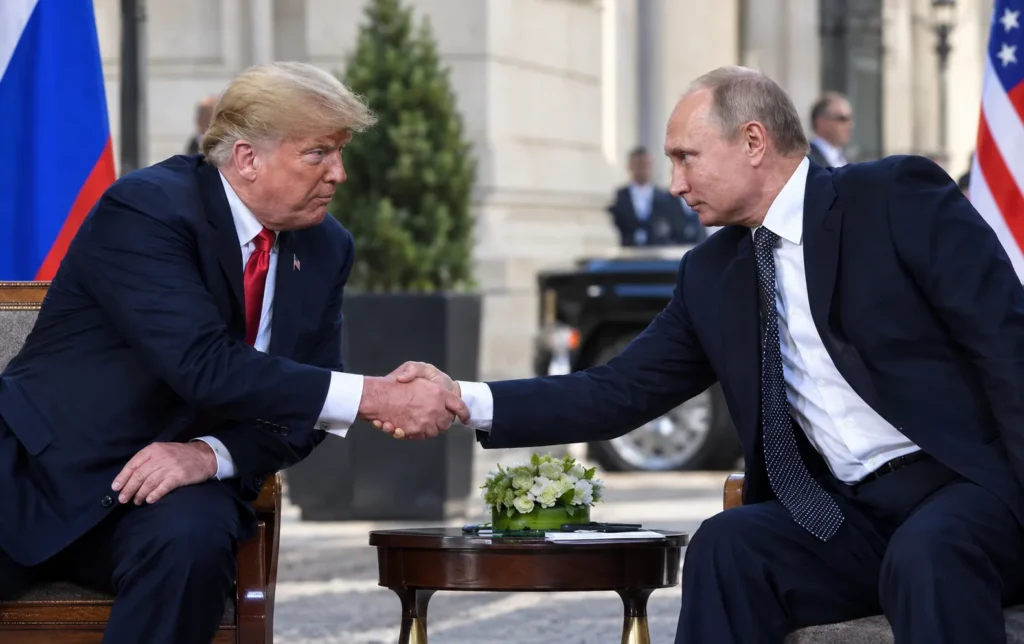
The relationship between Donald Trump and Putin has swung between warmth and pressure over the years. This timeline shows the key moments.
| Date | Event |
|---|---|
| July 2017 | First meeting at the G20 in Hamburg, Germany |
| July 2018 | Helsinki summit, widely criticised in the US |
| June 2019 | Meeting at the G20 in Osaka, Japan |
| August 15, 2025 | Alaska summit in Anchorage, no deal reached |
| September 2026 | Trump signs sweeping Russia sanctions law; presses Ukraine over refinery strikes |
| October 9, 2026 | Phone call and Russian diesel deal announced |
If you have followed these two leaders for a while, the pattern is familiar. Trump applies pressure, then reaches for a deal when domestic politics demands it. The diesel arrangement fits that pattern more than any earlier moment.
FAQs
What did Russia agree to supply to the US?
Russia agreed to send about 3 million tons of diesel in four phases. Around 500,000 tons should move immediately, with over 300,000 tons arriving in November. Later deliveries depend on how quickly Russia repairs its damaged refineries.
Are US sanctions on Russian diesel lifted?
Not fully. Treasury temporarily eased them through a general license that runs until April 2027. The broader ban on Russian oil imports that began in 2022 still stands outside this specific license.
Why did Trump make the diesel deal with Putin?
High diesel prices are hurting farmers, truckers, and voters ahead of the midterms. Trump also blames Ukraine’s refinery strikes for the shortage. The deal is meant to bring quick, visible relief before Election Day.
Will diesel prices drop because of this deal?
Analysts expect only a small effect, perhaps a few cents per gallon. Futures dipped after the announcement, but most experts say lasting relief depends on the Iran war and global refining, not Russian volumes.
Where was the last Trump Putin meeting held?
The last in-person Donald Trump Putin meeting took place at Joint Base Elmendorf-Richardson in Anchorage, Alaska, on August 15, 2025. Their latest contact since then has been by phone, including the October 9, 2026 call.
Did the call help Ukraine peace talks?
Not so far. The Kremlin said an immediate restart of peace talks was unlikely. Kyiv says the deal weakened its position, while Washington insists the Miami talks are still moving toward a roadmap.
Read About : batman and robin cast